

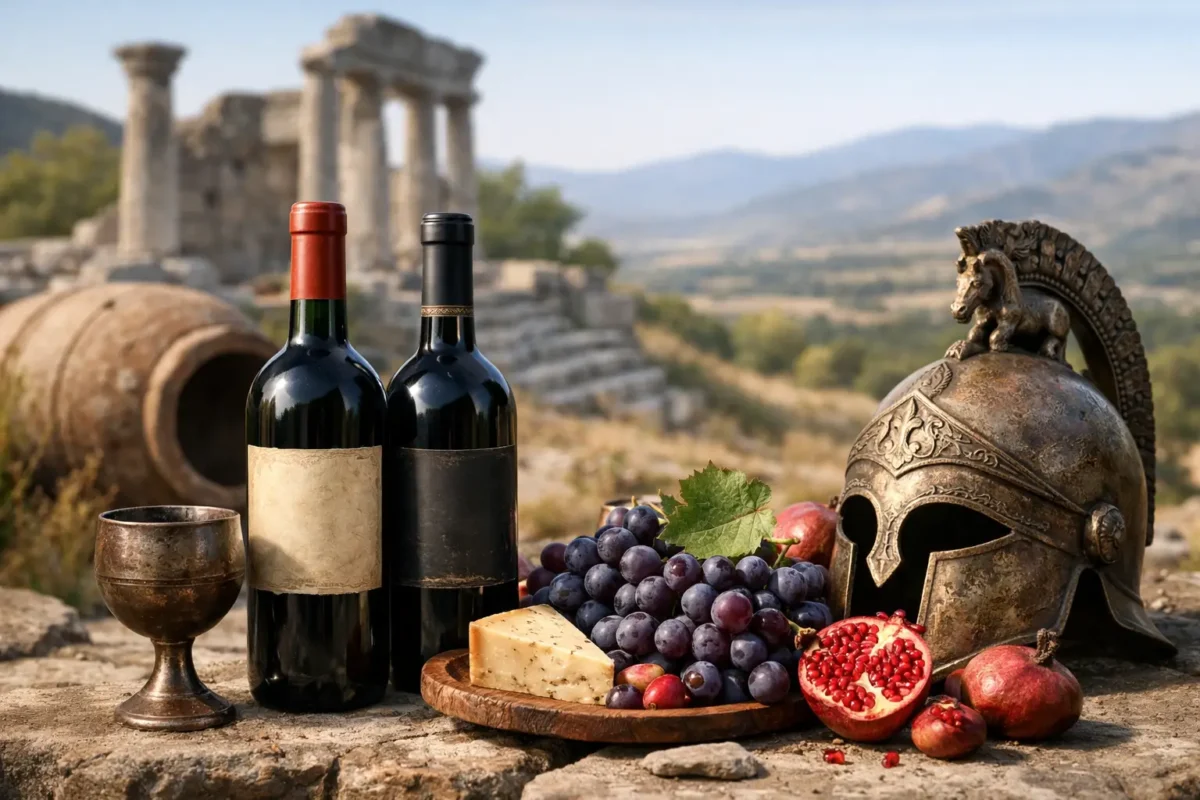
Long before Bulgaria appeared on modern wine lists, the Thracians were pouring wine for kings, warriors, and gods. Ancient Thracian winemaking history is not a decorative footnote – it is one of the oldest and most compelling foundations in European wine culture, and it still gives the Thracian Valley its singular authority today.
For buyers and wine professionals, that matters. Provenance is not a marketing accessory when it is this deep. In the Thracian lands, wine was never merely agricultural output. It was ceremony, status, diplomacy, and identity bound to place. That older meaning still gives the region a rare kind of credibility in a market crowded with familiar appellations and recycled stories.
Why ancient Thracian winemaking history still matters
The value of heritage depends on whether it shaped the wine culture that followed. In Thrace, it did. Archaeology, burial practices, metalwork, and written sources all point to a civilization where wine occupied a central role in daily and sacred life. Greek authors described the Thracians as notable wine drinkers. Tomb frescoes, ritual vessels, and ceremonial sets suggest not just consumption, but a developed wine culture with symbolism and hierarchy.
That distinction is important. Many regions can claim that grapes grew there early. Fewer can show that wine became part of political and spiritual expression. The Thracians did not simply ferment fruit. They folded wine into the architecture of power. In practical terms, that gives modern Bulgarian wine a stronger narrative than many newer premium categories trying to invent mystique from scratch.
The land behind ancient Thracian winemaking history
The Thracian world stretched across lands that now include much of modern Bulgaria and neighboring territories. Its most resonant wine legacy lives in what is now the Thracian Valley, a region favored by warm days, moderating influences, and soils capable of producing concentrated, characterful reds.
This is where the historical story meets commercial relevance. Ancient prestige means little if the land cannot still deliver. The Thracian Valley can. Its climate supports ripeness and structure, while elevation shifts and site variation preserve nuance. For producers focused on estate-grown fruit and regional identity, this is not nostalgia. It is continuity.
The best heritage stories work because geography confirms them. In the Thracian Valley, the terrain does exactly that. The wines carry sun, depth, and a certain Old World gravity that feels earned rather than styled.
Wine as ritual, not refreshment
To understand ancient Thracian winemaking history, it helps to set aside the modern habit of treating wine as either luxury or lifestyle. For the Thracians, wine had sacred and ceremonial weight. It appeared in feasts, funerary contexts, and elite gatherings. Gold and silver rhytons, amphorae, and cups recovered from Thracian tombs suggest a culture in which the vessel itself signaled reverence.
This ritual dimension matters because it shaped how wine was valued. A people who bury elaborate wine service objects with their dead are telling us something clear: wine belonged to memory, honor, and the afterlife as much as the table. That sense of significance still shadows the region’s best wines. They ask to be regarded, not merely consumed.
There is a temptation to romanticize all this, and trade buyers should resist easy mythology. The Thracians were not preserving wine for a modern tasting room fantasy. Their world was harsher, more stratified, and deeply tied to religious practice. But precisely because the context was real and not invented for tourism, the story retains force.
How the Thracians made and moved wine
No honest account of ancient Thracian winemaking history can pretend we know every detail of cellar technique. We do not. Evidence comes in fragments – vessels, settlement remains, tomb goods, trade patterns, and external accounts. What emerges is a picture of organized viticulture and wine exchange rather than casual household production alone.
The Thracians cultivated vines in a region naturally suited to them, and they were connected to active trade networks in the ancient Balkans and Aegean world. Greek contact influenced vessel forms and drinking customs, yet Thracian wine culture retained its own identity. This is one of the most interesting tensions in the story. Thrace absorbed outside influence, but it was never merely derivative.
That pattern feels familiar even now. Bulgarian wine sits at a crossroads of East and West, local distinctiveness and international readability. For importers and restaurant programs, that balance is often an advantage. A wine can feel accessible in style while remaining unmistakably rooted in place.
As for production, ancient methods would have been shaped by what the era allowed – hand harvesting, simple crushing, fermentation in clay or other available containers, and storage that depended on climate and craftsmanship rather than modern precision. The trade-off is obvious. Ancient wines likely varied far more from batch to batch than premium wines do today. Yet variability should not be confused with lack of sophistication. Different age, different standards.
Greek influence, Thracian identity
Thrace and the Greek world were deeply entangled through trade, warfare, and cultural exchange. Greek writers often framed Thracian drinking through their own lens, sometimes admiring it, sometimes caricaturing it. That means the record is useful but not neutral.
Still, the overlap tells us something valuable. Thracian wine was visible enough to enter the wider cultural imagination of the ancient Mediterranean. It was not hidden, provincial production. It belonged to a region people noticed.
For modern positioning, that visibility matters. The strongest wine stories are rarely isolated ones. They are stories of regions that participated in larger civilizations while keeping their own profile. Thrace fits that pattern well. Its wine heritage is both local and historically connected, which is exactly the kind of depth that resonates in premium retail and by-the-glass discovery.
From antiquity to the modern Thracian Valley
History alone does not guarantee quality in the bottle. Plenty of old wine regions have spent centuries producing indifferent wine. What gives the Thracian Valley unusual appeal is that the ancient inheritance meets a modern revival of serious estate-focused winemaking.
Today, the region’s premium producers are not trying to recreate antiquity literally. They are doing something more convincing. They are carrying forward a civilizational relationship with wine while applying modern discipline to farming, selection, and vinification. That is the right balance. Buyers want authenticity, but they also want consistency, polish, and wines that can perform on shelves and lists.
This is where the old story gains new relevance for red wines in particular. The Thracian Valley has the warmth and structure to produce reds with presence, and it also has a heritage language powerful enough to support premium positioning. For a market accustomed to Bordeaux, Tuscany, Napa, and Rioja, that creates a compelling alternative: familiar seriousness, different lineage.
A wine such as Mavrud makes that point especially well. It carries regional specificity that cannot be copied elsewhere, yet it belongs naturally within a fine-wine conversation. Merlot and carefully built blends can broaden access, but the underlying appeal remains the same – deep roots, estate character, and a region with something real to say.
Ancient Thracian winemaking history as a modern advantage
There is always a risk in heritage-led branding. If the history overwhelms the wine, the result feels theatrical. If the wine ignores the history, it becomes interchangeable. The best producers understand that ancient Thracian winemaking history should act as foundation, not costume.
For trade buyers, that creates practical value. A wine with genuine historical depth can stand out in a crowded category without resorting to novelty. It gives sales teams a story worth telling, retailers a point of difference, and restaurant programs a bottle that invites conversation. More importantly, it supports price integrity when the quality is there.
For consumers, the appeal is emotional as much as sensory. To pour a wine from the Thracian Valley is to pour from a landscape where vines have been tied to ritual, prestige, and memory for millennia. Taste the land, and you taste continuity.
Rhesus Wine speaks to that continuity with unusual clarity because the story is already in the ground. The task is not to embellish it. The task is to honor it with wines worthy of the region.
The oldest wine stories survive because they still feel alive at the table. Ancient Thracian winemaking history is one of them, and for those willing to look beyond the usual map, it offers something increasingly rare: not just another red, but a true inheritance in the glass.